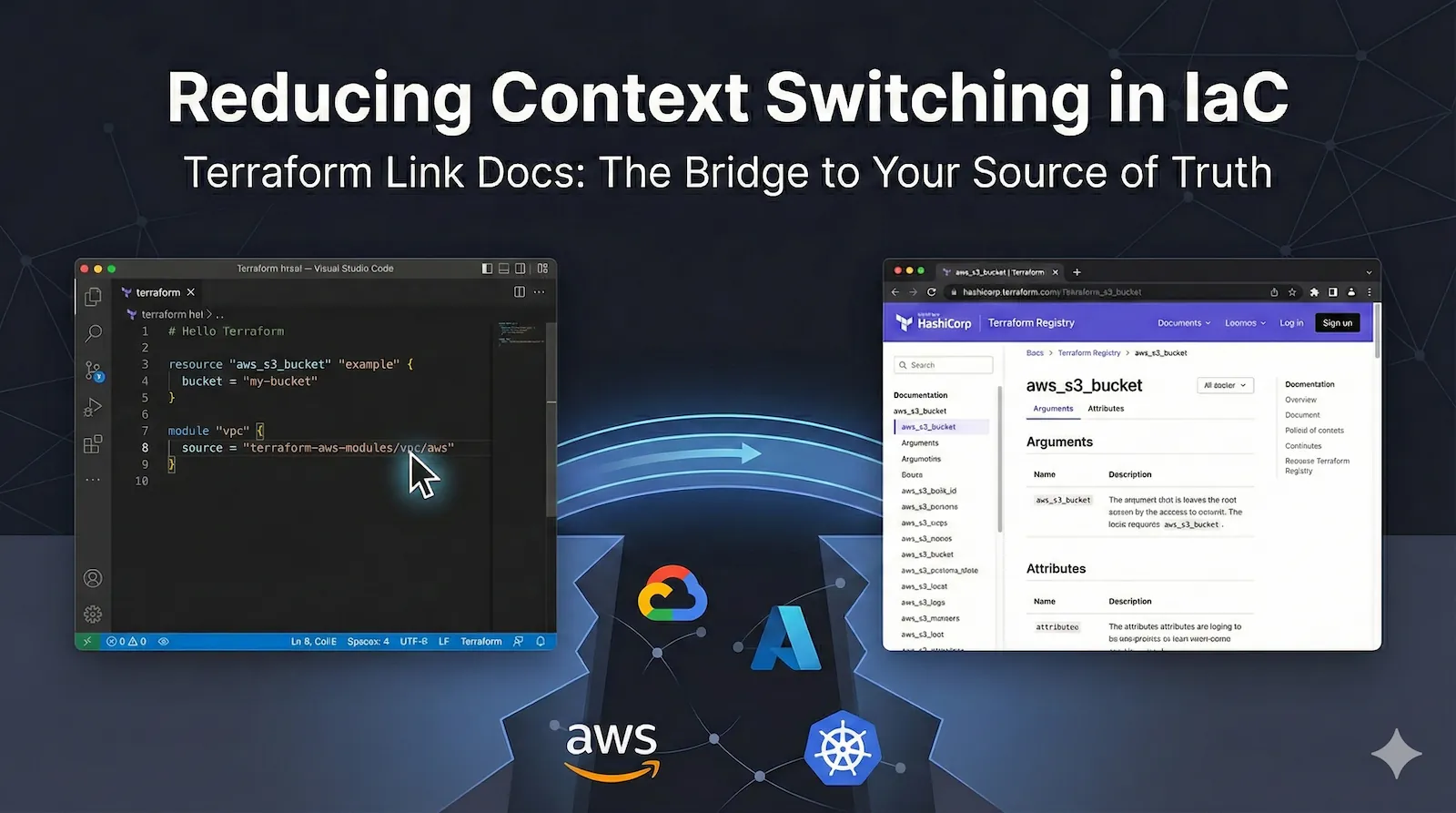
Infrastructure as Code (IaC) has revolutionized how we deploy systems, but the developer experience remains fragmented. Even for seasoned engineers, the gap between writing a resource block and verifying its arguments or outputs is a persistent friction point. In the age of AI-assisted coding, this has shifted from a search for syntax to a mission for verification. We are writing code faster than ever, yet we still find ourselves losing mental bandwidth in the browser, double-checking the "source of truth." To minimize this tax, I built Terraform Link Docs, a VSCode extension that bridges the distance between your editor and the Registry, keeping you in the zone by making documentation a single click away.
The Friction of the "Source of Truth"
Every software engineer knows the "context switching tax." It's the hidden cost of what should be a brief, three-second search for documentation that inevitably spirals into a five-minute distraction. Whether you are hunting for the specific arguments of a resource, verifying the available outputs of a legacy module version, or checking if an attribute has been deprecated, the "Source of Truth" is rarely where you actually need it.
In the age of AI-assisted coding, this friction hasn't vanished, it has evolved. While LLMs can scaffold an entire VPC in seconds, they are notoriously "confident" about syntax that might be two versions out of date or entirely hallucinated. This has forced a shift in our workflow: we aren't just writing code anymore; we are verifying it.
When AI suggests a new argument, the "mission for verification" begins. If that requires multiple clicks, browser tabs, and manual searches through the Terraform Registry, your flow state is gone, death by a thousand clicks. The cognitive recovery required to return to your logic after navigating a sea of documentation is a heavy price to pay for a simple "trust but verify" check. By the time you find the right page, you might even be left wondering, "Wait... what was I doing again?"
An Antidote - Terraform Link Docs
I built Terraform Link Docs to be the bridge across that gap. The goal was simple: take the documentation out of the browser and bake it directly into the editor. By transforming static HCL strings into live, clickable portals to the "Source of Truth," we can effectively eliminate this context switching tax.
The core of the extension is a low-latency feedback loop. When you're looking at a resource like aws_instance or a datasource like aws_ami, you shouldn't have to search for it. You simply click, and the extension handles the heavy lifting of finding the exact documentation page for that specific provider.

Solving the "Non-Standard" Problem
One of the biggest friction points in IaC is working with the broader ecosystem. While many tools support the "big three" (AWS, Azure, GCP), the experience falls apart the moment you touch a community or partner provider or internal modules.
Terraform Link Docs solves this by:
Parsing
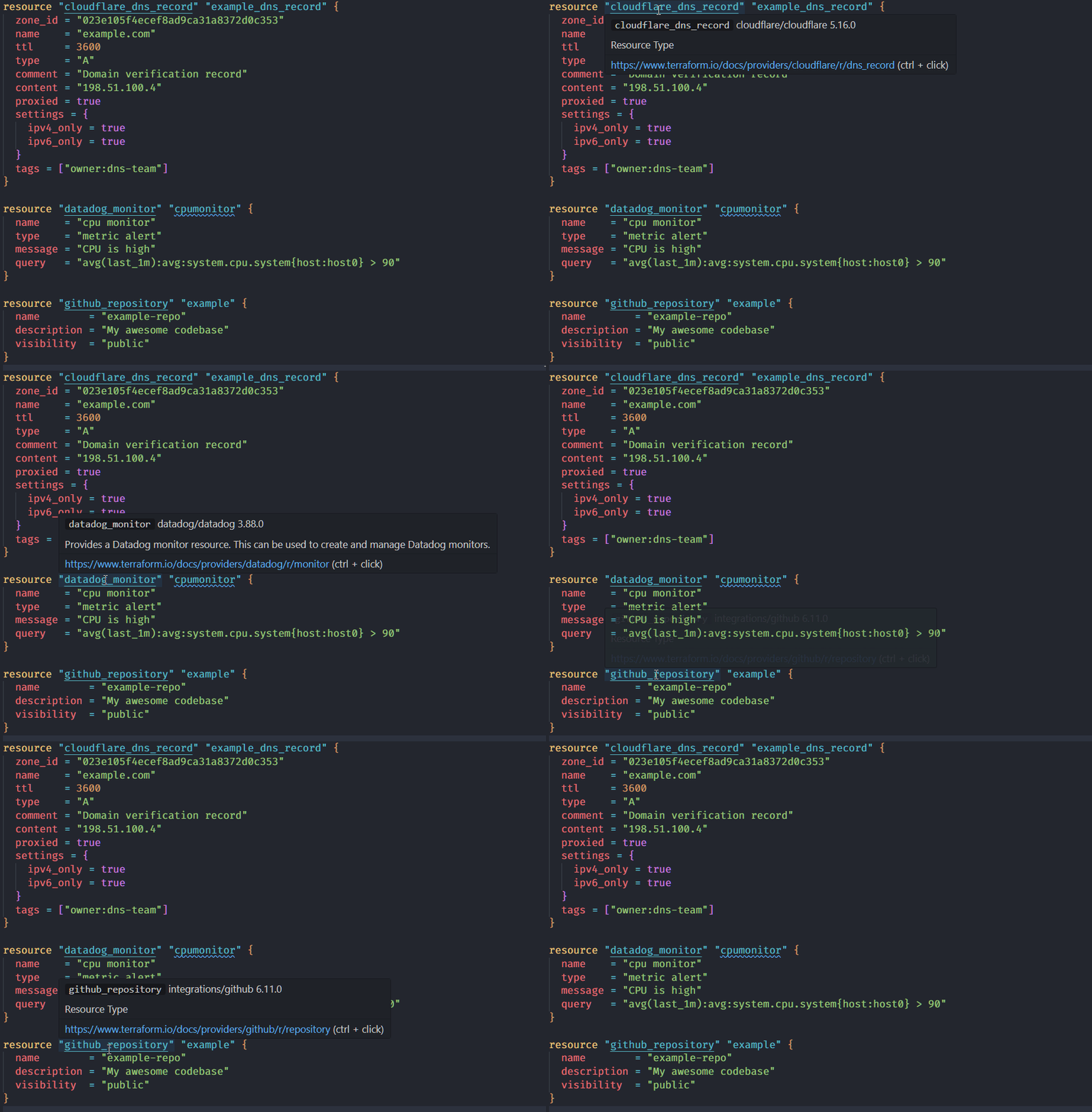
required_providers: It looks at your configuration to correctly link resources from providers like Cloudflare, Datadog, or Tailscale to their specific Registry pages.Deep Module Integration: Whether your modules are hosted on the Terraform Registry, GitHub, Bitbucket, or even referenced via local paths, the extension generates a direct link to the source. It even handles complex Git references like specific SHAs or tags, essential for that "mission for verification" when using pinned versions.
Designed to be Invisible
Good developer tools should feel like they were always part of the IDE. This extension is designed to be lightweight and stay out of your way until you need it. There are no heavy UI overlays or intrusive pop-ups, just a clean way to get the information you need, verify your AI's suggestions, and get back to building.
Real-World Impact: ... Installs and Counting
When I first released Terraform Link Docs, I wasn't sure if the "Context Switching Tax" was just a personal pet peeve or a widespread industry pain point. The response from the DevOps community has been a clear validation of the latter. With all the installs and feedback from infrastructure engineers at companies, it's clear that "verification latency" is a challenge we are all facing.
The most rewarding part of this project has been its evolution through open-source collaboration. The community has been instrumental in making this tool more robust. For instance, the enableCommunityProviders setting was born directly from user feedback. Engineers needed a way to bridge the gap for partner and community-tier providers that are often treated as second-class citizens in standard IDE tooling. By listening to how people actually use Terraform in production, the extension has grown from a simple link-generator into a sophisticated HCL parser that respects the nuances of modern provider blocks and module sources.
Reclaiming the Flow State
At the end of the day, documentation shouldn't be a destination you have to travel to, it should be a natural part of the environment you work in. In a world where AI can generate code faster than we can read it, the tools that protect our Deep Work and minimize cognitive recovery are more valuable than ever.
By bringing the "Source of Truth" directly into VSCode, Terraform Link Docs isn't just saving you a few clicks, it's protecting your mental momentum and helping you maintain the clarity required to build complex systems.
Get Started & Contribute
If you're tired of the "death by a thousand clicks," you can grab the extension today and start reclaiming your mental bandwidth:
- Install it here: Terraform Link Docs on the VSCode Marketplace
- Collaborate: GitHub Repository